
Nuremberg (2025)
and the Limitations of Conventional Cinema.

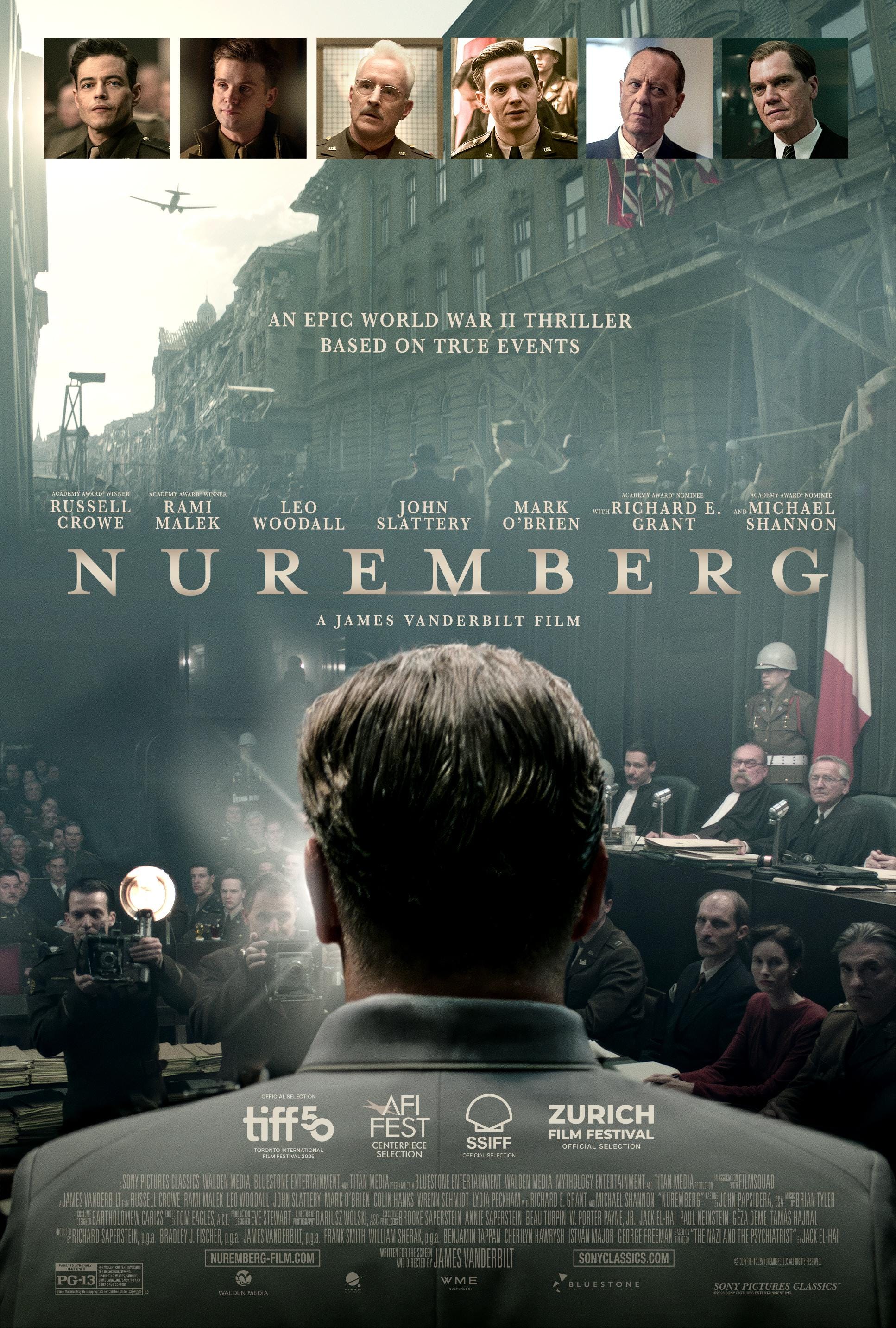
Among the heaps of prestigious historical dramas perennially vying for Oscar consideration, Nuremberg is a film worthy of attention beyond The Academy’s Best Supporting Actor category. It’s a film whose supreme importance lies in its content, not its presentation.
That’s because Nuremberg is, for the most part, a conventional film seeking to grapple with the Nazi’s unfathomable atrocities and the banality of evil. That’s a lot of thematic weight to stuff in conventional cinematic packaging, and it’s difficult to gaze into the abyss when the movie is still, at least partially, committed to being “entertainment.”
Solemnity is certainly part of the Nuremberg cinematic experience, but I expected it to be pervasive. The thematic material (i.e., Nazi war crimes) is heavy, like a lead vest for the soul, yet James Vanderbilt’s film makes a concerted effort to keep things outside the trial itself conspicuously breezy. I’m not saying that Nuremberg can’t employ levity; I’m questioning if it should, and to what end.
As our ensemble cast of characters zips through Nuremberg spouting quippy dialogue, I experienced a profound dissonance. Mainstream films conceptualize themselves as entertainment. Success, within that traditional framework, is predicated on audience enjoyment. Who’s going to pay to see a movie they won’t enjoy?
The insistence that film needs to be “enjoyable” limits the medium’s potential. To accomplish something meaningful, sometimes a filmmaker needs to provoke negative emotions that leave you, the viewer, feeling “bad.”
If the cinematic form is meant to explore the darker corners of the human condition, and it should, there is an unavoidable reality that filmmakers and audiences need to confront: you are not entitled to a “good time at the movies.” Sometimes audiences should be left to wallow in misery and anguish. That’s what I think Nuremberg ought to have striven for.
Broadly speaking, I think cinema should strive to engage audiences rather than entertain them. Making a “feel-bad movie” will undoubtedly impact its commercial viability, but sometimes sacrificing commercial viability is the difference between making an entertaining movie and crafting a work of art worthy of admiration.
Unfortunately, Nuremberg is committed to being an entertaining movie.
Rather than a procedural exploration of the banality of evil, our narrative deemphasizes the trial itself. Instead, the film hinges on the relationship between Hermann Göring (Russell Crowe) and Douglas Kelley (Rami Malek), the American psychologist tasked with analyzing Hitler’s second-in-command. Fascination blossoms, and their relationship evokes the dynamic between Hannibal Lecter and Clarice. At times, I wondered if their discussions of the Third Reich ought to be accompanied by some fava beans and a nice Chianti.

Despite the shortcomings in Nuremberg’s approach to the material, it still has powerful moments and profound resonance.
The most affecting moment of the film occurs during the trial, when the prosecution presents historical footage from liberated Nazi camps. The piles of limp bodies, the way their limbs flop as a bulldozer pushes a heap of corpses towards a mass grave… It wasn’t the first time I’d seen such atrocities captured on film, but the overwhelming indignity will never cease to be staggering.
The footage is appropriately situated in Nuremberg, both thematically and narratively. But it begs the question: if historical footage is the most impactful part of Nuremberg, would audiences not be better served by a documentary?
Maybe, but maybe not.
Documentary footage might be the best way to confront audiences with the horrors of systematic genocide, and films like Shoah (1985) have taken on that task successfully. For its part, Nuremberg employs its historical drama to pose pointed questions about justice and accountability for the actions of geopolitical leaders. In reenacting the indictment of the 20th century's most irredeemable, universally condemned political regime, Nuremberg turns its eye to contemporary fascist war criminals leading the world in the 21st century.
The Nuremberg Trials, spearheaded by U.S. Supreme Court Justice Robert H. Jackson (Michael Shannon), were a stunning display of international cooperation and multilateral condemnation of the Third Reich’s actions. Rather than simply shooting the surviving members of Hitler’s Reichsregierung, the Nuremberg Trials sought a version of public transparency and legal accountability that could only occur in an international court, which, until the Nuremberg Trials, never existed.
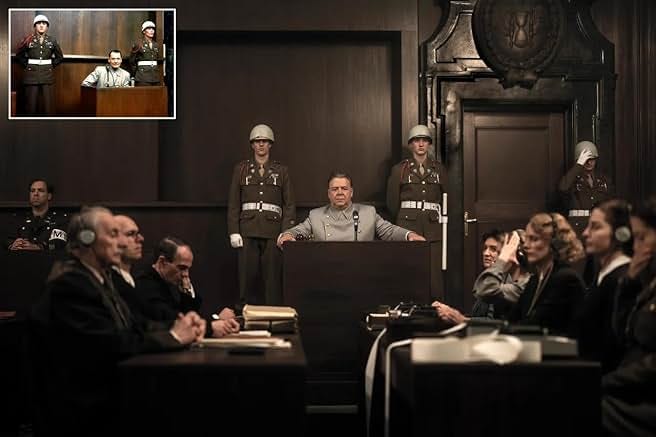
While I don’t think Nuremberg is well-served by levity, there’s no denying the grim irony underlying the fact that two contemporary states in dire need of accountability via a Truth and Reconciliation process are:
A) the United States, which failed to indict its former president (multiple times, and in multiple ways) for his administration’s concerted efforts to subvert democracy and overturn the results of the 2020 presidential election.
Trump’s second Congressional impeachment and subsequent Senate trial resulted in his acquittal. Despite voting to acquit Trump, Senate Minority Leader Mitch McConnell (R - Kentucky) made it unequivocally clear that Trump was directly responsible for the January 6th insurrection, but passed the buck to the Justice System to hold the former President accountable.
The subsequent Presidential administration, led by Joe Biden, feared the political optics surrounding the unprecedented prosecution of a former President. Biden’s Justice Department, under the leadership of Merrick Garland, prized the illusion of normalcy over the pursuit of legal accountability.
So, the Justice Department kicked the can back to Congress, where the Democrat-led House of Representatives established a bipartisan “Select Committee to Investigate the January 6th Attack on the United States Capitol.” The 845-page report compiled by the committee, released in 2022, was effectively negated by Trump and his goons declaring that the committee’s work was a politically motivated “witch hunt.”
In the absence of any real accountability, Trump successfully returned to the Oval Office. His second administration has worked tirelessly to revise history, pardoning his coconspirators and recasting them as maligned patriots. Trump’s regime has successfully purged the United States government of apolitical bureaucrats.
Most distressing is his dismissal of the U.S. military’s top brass without cause, ostensibly for their resolute, non-partisan commitment to the peaceful transfer of power in 2020 and necessary disregard for President Trump’s agenda. The commitment to serving the Constitution above the will of the president will not be tolerated in Trump’s second regime.
Trump and members of the Republican Party have outright stated their intent to circumvent the Constitution and keep Trump in office for a third term. His administration has deployed troops into cities, kidnapping people in broad daylight under the guise of “immigration enforcement.” He has sought to chill dissent, bringing prominent law firms, universities, and broadcast companies to heel.
To ignore the parallels between those on trial in Nuremberg and the charismatic narcissist leading a political party composed entirely of sychophantic ultra-nationists today is to bury your head in the sand.
and…
B) Israel, whose criminal administration has waged a genocide under the pretext of Jewish security. How can one look at horrors on display in Nuremberg, say “never again,” and square that with the Netanyahu regime’s ethnic cleansing of Palestine post-October 7th? You can’t unless you’ve also buried your head in the sand.
And so Nuremberg offers much to think about, and with that, much to consider. It’s a deeply flawed film whose commitment to entertainment undermines its thematic significance, but by no means is it a waste of time. If anything, the film’s shortcomings have encouraged me to delve into the historical literature for myself so that I might understand what Nuremberg is simply unequipped to communicate.
Thanks for reading Acquired Tastes, my fellow film freak.
Until next time (and forevermore) fuck Nazis past, present, and future.
Not sure if you’ve seen Warfare yet… but that movie immediately came to mind when you mentioned that audiences don’t necessarily deserve to be entertained. Warfare was probably the most brutally accurate film I’ve ever seen in my life… and I’m not sure what it says about me when I say this, but I didn’t particularly enjoy it.